- May 17
The Scent of Somewhere Else: What Your Nose Knows About Healing
- Eka Kapiotis
- Brain Work, Nature's Wisdom
- 0 comments
I got instantly transported to South America the other morning. It was quite a surprise, since I was doing the same thing I do most mornings: making a bowl of cereal with fruit and nuts sprinkled on top.
But there I was—suddenly—feet on rich soil, warm, moist air on my skin, lines of banana palms stretching out with paths between the rows.
The power of smell.
When I peeled back the skin of my morning banana, the aroma was like perfume: rich, sultry, evocative. I had to shake myself out of the fantasy and come back to the task at hand so I could get to work.
The olfactory nerve—your sense of smell—is the first cranial nerve, and it developed early in the history of life, even before eyes and ears appeared. Unlike other nerves, it connects directly to the primitive, emotional parts of the brain, bypassing the rational, executive-reasoning parts. It's so essential to life because it gives you direct, immediate information to help you find food or avoid danger.
Smell is so potent that a single whiff of something familiar can transport you instantly back to a time or place. Think of something baking, or a cinnamon roll. You feel warm all over before you even take a bite.
And if you've ever wondered why certain smells feel like coming home, there's a beautiful reason for that…
When Benny and I take our morning walk, he always slows in front of our neighbor's house down the road. He lifts his nose into the air, and it wiggles back and forth as he navigates aromas only he can detect.
I use the word navigate because I can almost see him traveling through their house, carried aloft on things only he can smell. If I could read his mind, it might be a little embarrassing… I'd be a co-voyeur. I imagine he knows what they had for dinner, what's on for breakfast, how their dog Acorn is doing, and other things that only he finds important.
Last year, I thought I'd lost my sense of smell. Well, I had, but it wasn't permanent. I took a class in October where we worked with cranial nerves, and my sense of smell was restored. Hallelujah!
Losing your sense of smell can be deeply disorienting and even lead to depression. It matters that much to our well-being.
Life gets busy, and it's surprisingly easy to stop noticing smells altogether. Here's a gentle way to come back.
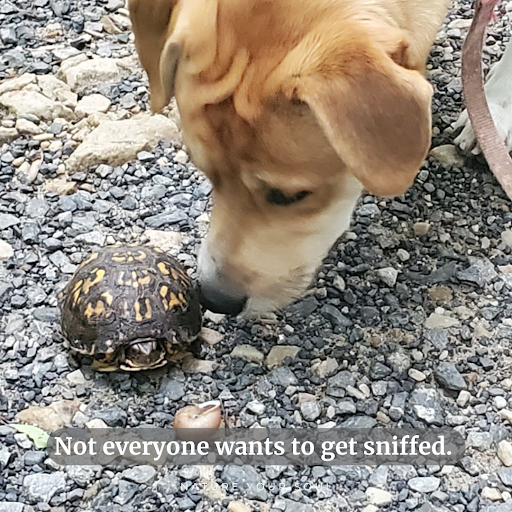
Here’s a 3-Minute Tiny but Mighty Practice to help you enjoy your most basic sense more:
Take a sniff walk. It can be through your pantry, your bathroom closet or even better, outdoors.
Step outside and just breathe in the air. Linger over any flowers, herbs, or earth you find.
Let your curiosity lead you. No agenda. Just your nose, doing what it was made to do.
Your senses are little portals, always ready to bring you home to the present moment… or whisk you off to a banana plantation in South America.
Either way, Nature is always offering something. All you have to do is breathe in.
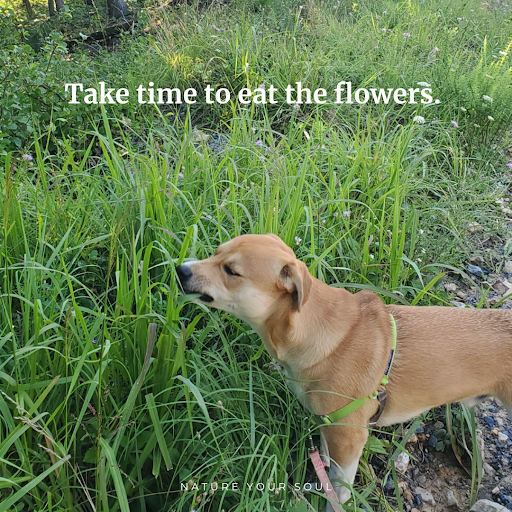
Smell and the Natural World
Smell has a way of transporting you to different places through memories and associations. One whiff and suddenly you’re out of your living room and exploring some of your favorite (or not so favorite) places. You’re reliving beautiful and devastating moments.
This instant transportation is actually exactly what Nature intended smell to do.
Nature has been communicating through scent long before humans were around to notice it, and we are still wired to receive those messages. Smell is arguably the most important sense, even if it seems like one we could live without.
The Forest Speaks in Scent
There’s a little something called phytocides. These are organic compounds released by trees, particularly conifers, as a form of communication and self-defense.
Here’s what happens: When we breathe them in, our bodies have a natural response. Research shows that phytocides actually lower your cortisol, reduce blood pressure, and increase NK (natural killer) cells that support immune function.
Moral of the story… If you’re feeling stressed, go and find a conifer tree and take some long, deep breaths underneath it.
This is part of the science behind Shinrin-yoku, aka Japanese forest bathing. The thought is that the forest is literally medicating you through your nose. This has actually become a vital part of preventative medicine in Japan. Japanese doctors will actually prescribe forest bathing.
And the results are amazing.
Simply put, we don’t just enjoy the smell of the forest… we are biologically designed to be healed by it.
Petrichor: The Smell of Rain on Earth
Okay, you know the smell. When it’s been dry and suddenly it rains, and the smell of that fresh rain on the concrete and earth? That’s a powerful smell.
Petrichor… The word was coined in 1964 from the Greek petra (stone) and ichor (the fluid that flows through the veins of the gods).
But what creates this specific smell? It’s geosmin, a compound released by soil bacteria when rain hits dry earth, plus plant oils that have been absorbed into the ground during dry periods.
Believe it or not, humans are extraordinarily sensitive to geosmin. We can actually detect it at concentrations as low as 5 parts per trillion. For context, this is more sensitive than sharks are to blood. Pretty cool when you think about it.
But why is this necessary? What does this actually do for us?
Evolutionarily, the smell of rain meant water, food, and survival mechanisms were coming. And while some of these early instincts have left us, our bodies still respond with that ancient, cellular relief.
When we smell that fresh rain smell, our bodies feel warmth, comfort, and hope.
Flowers and the Language of Fragrance
I would be remiss if I didn’t talk about flowers when I am writing an article about smell. Somehow, a house always feels lighter when there are flowers there. And while yes, flowers are pretty to look at, ultimately, it’s their smell that really helps create a calming and happy presence.
Flowers didn’t evolve their scent for us, though. They evolved it as a form of communication to attract pollinators and ensure their survival was guaranteed. Yes, flowers smell good to us, but they also smell really good to little bumblebees whose jobs are to pollinate and keep those flowers alive.
While their scents aren’t actually for us, we have been receiving that message for thousands of years, and it deeply moves us.
Different flowers have different scents, and those scents signal different things to our nervous systems and other systems in our bodies.
For instance:
Rose—A heart-opener, and it is emotionally softening.
Jasmine—Is uplifting, almost euphoric. A good one to have in times of sadness and despair.
Lavender—A good nervous system regulator. Many people love lavender in its essential oil form for this reason.
Lilac—Helps with memory, nostalgia, or a sense of being held. See our article from last week!
A common phrase is “Stop to smell the flowers,” but when we do this, we are actually participating in a sacred conversation that was never meant for us… But somehow, we are always welcome. Knowing that, make sure you always respect the smell of flowers.
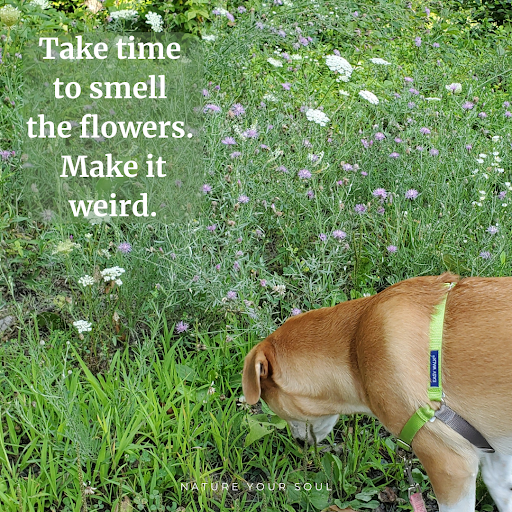
Nature has always been sending messages. Scent is one of our oldest languages.
And because of how our brains are wired, it is also one we receive most directly… straight to the heart, bypassing the thinking mind entirely.
Scent hits us hard and instantly.
Never underestimate the power of smell.